
Amrou Al-Kadhi calls themself on their website a “Professional Unicorn. Queer Iraqi non-binary Brit.” Actor, film-maker, writer, performer and drag queen (under the name of Glamrou), they moved from the Middle-East to the UK (where they studied and now live) with their family at the age of 11. Last year they published their first book: “Unicorn, The memoir of a Muslim drag queen” (HarperCollins), which is being released as a Paperback in May, under the new title: “Life as a Unicorn: A journey from Shame to Pride, and everything in between.”
Today you are a public figure, committed to your identity of LGBTQIA Muslim. In the introduction of your book, however, you write about a time when you felt “too gays to Iraqis and too Iraqi for gays”, and that being non-binary makes you feel uncomfortable in the gay community. What makes you feel an outsider in these two communities and what makes it difficult, still today, to be Muslim and LGBTQIA?
To be honest, I no longer feel uncomfortable about my identities as such – I feel empowered and proud. This doesn’t change the fact that there are very few spaces where I feel entirely welcome. I’m gay in the fact that I mostly have sex with men, but gay spaces are a site of real anxiety for me; the over-performance of masculinity, the fact that white men are sexually quite racist – they either have a rule of not sleeping with people of colour or are absurdly fetishistic.
Read also: Interview to Mr. Leather: “I Am Gay, Fetishist and Muslim”
And in recent years there has been real Islamophobia in the gay community (1/3 of married gay men in Paris voted for Marine Le Pen…). I think so many gay men have struggled to find acceptance early in life, that as adults, once they feel like they have space, repeat those cycles of exclusion, and unfortunately, they get taken out on femme brown people like me.
And as I explore in my book, my family life and culture in the Middle-East was incredibly hostile to my queer identity, and a lot of the trauma that occurred growing up has left a lot of residual scarring for me. For a long time, it took me a while to even go into any Arab spaces because of what I experienced growing up, but I’ve recently been using my drag to recover things from my childhood in the Middle-East that were really important for me.
 Reading your book, I see that acting, performing and being a drag performer has been of great relevance for you in your path. But you experienced discrimination in your career. Just two years ago you spoke out against stereotyping and typecasting in cinema. You denounced that, as an Arab actor, you were exclusively cast as a terrorist or, at best, the antagonist of white heroes…
To be honest, if you’re a white masculine gay male actor, you’re fine these days…for femme and brown people, it’s a different story. I mean, the industry is changing and there is a lot more work for people of colour now, but I felt so disenfranchised that I just started writing my own scripts for TV – at first, things for me to be in, but now I write scripts for other people’s TV shows too, and that has been incredibly empowering. There is such little space for authentically queer and diverse spaces, so I just thought – I’ll create one!!!
So to any performers from minority backgrounds looking for work, I’d say, write your own script, get on Kickstarter and raise some money, and make a short film. Then you can write something that is authentically you and to be honest, that is the best thing to be.
Read also: Allah Loves Equality: to Be LGBT in Pakistan
What do you think about typecasting for actors part of the LGBTQI community?
I hate the fact that the gay actors who do well often having to resort to acting in a way that is palatable for the masses. I wish there was more authentically transgressive and “ugly” acting for queer people…also, why do all gay people have to be so pretty on screen? I think this proliferates feelings of shame among queer people who do not live up to those aesthetic standards, and it would be great to see more authentic kinds of representation on screen.
Once actors had to hide their sexual orientation to work (see Rock Hudson or Richard Chamberlain). While we were getting rid of this, now there is a whole new “woke” trend: according to it, gay characters must be played by gay actors, who are at risk of being typecast for their sexuality. What is your opinion about that?
I go back and forth about this. My feeling is, that straight actors get celebrated SO much whenever they have the ‘bravery’ to play a gay role. Like…fuck off!! You’re not doing charity work bitch! I’d like to see an industry where gay people are genuinely considered for all roles, not just gay ones, and then I think I’d have less of a problem with straight actors playing gay roles. What I do hate is the fact that so often, gayness is played with a real sense of masculinity by straight actors, and it’s a shame we don’t see more authentically femme gay roles on screen. That is what would really make a difference.
 Though cis actors should not be allowed to play trans roles, PERIOD. It’s already absurdly hard finding roles as a trans actor, and they are NEVER invited to play cis roles. So literally, fuck off to Jared Leto in Dallas Buyers Club [a 2013 film directed by Jean-Marc Vallée; ed] – that should have been a trans actor, who could have had a life-changing opportunity, and I’m still furious it wasn’t.
Cinema contributes to spread Islamophobic stereotypes, but islamophobia and racism are present in society and being LGBTQI, unfortunately, it’s not an antidote. For some years now far-right parties such as Rassemblement National (National Rally; RN) in France have been successful also among LGBTQI people and in Italy several LGBTQI people have expressed their support to the far-right Lega (League) of Matteo Salvini. Can you tell us about the situation in the UK and where do you think it is going?
Britain is a shithole right now, as are most European countries. Essentially, the failure of capitalism is becoming exposed, and the fact that it has entrenched such intense inequality. The Right, however, who have such control of the media, have been able to blame the failure of capitalism on migrants and Muslims who are either coming to steal all our resources or are coming to destroy Western democracy. They’ve reframed the conversation so that we don’t look at their own mistakes at destroying society and pinned it all on a vulnerable few.
Capitalism has failed over and over again, and whenever it does, vulnerable immigrants and peaceful Muslims are to blame for it. The Brexit vote was essentially people rejecting the capitalist status quo, and it was morphed into a xenophobic project. This is happening everywhere in the West. However, I do feel that Coronavirus is revealing the fault lines of capitalism in a way that the Right cannot control – the damage the private sector has done and the issues with individualism – and perhaps once we’re out of it, we’ll have a more compassionate society that values others and what they contribute. Or immigrants will just be blamed again like Trump and Boris are trying to do. So maybe we’re just fucked
Read also: Coronavirus and Migrants: Italian Associations Make an Appeal
Being both Muslim and LGBTQIA is often considered impossible, but we know that it isn’t. You talked about pockets of queerness in the Quran, a statement which could startle both Muslims and LGBTQIA activists, can you talk to us about the queer in the Quran?
I don’t want to give away too much in my book, but I think what’s important for people to know is that Islam for centuries was very tolerant, and there are all kinds of examples of gender and sexual diversity in Islamic history, with practices like Sufism being incredibly diverse. The Quran also has no explicit condemnation of homosexuality, and there are examples of Islamic poems centuries ago that have lots of homoerotic desire.
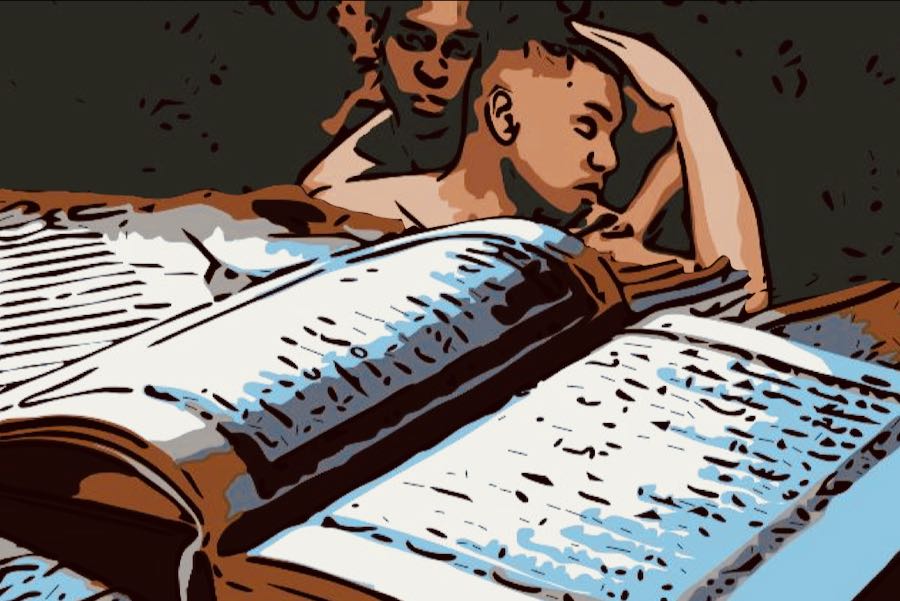 Unfortunately, British colonialism exported homophobia and “enlightenment” sexual and gendered taxonomy to the Middle East and the Global South, and part of the reason the Middle East is so hostile to difference right now is the legacy of British colonialism. So to anyone in Britain who looks to the Middle East and thinks it’s regressive, I would ask them to confront their own colonial history first – which isn’t even taught in British schools. I wonder why…
Do you think that a Muslim LGBTQIA community exists today and that it expresses its own culture? In the European Islamic communities specifically, is it possible to be openly LGBTQIA today? Your faith is present also when you are Glamrou and it is present in some of your performances and shows. How reacted to this the Muslim community in the UK?
I’ve had death threats and all kinds of hate. I’ve also had a lot of people thank me. There are lots of queer Muslim spaces around the world. I think it feels like queer Muslims have always existed, and even if we do so in the fringes, we are here. And broadly speaking, people who buy tickets to my drag shows know that I will always transgress the lines and push the boat. I’ve always been like that, and I see my job as constantly providing counter-narratives to the dominant ones across the globe. I’ll never pander to whiteness or heteronormativity, and to anyone who can’t handle that – bye bitch.
Because of the pandemic of COVID-19, Muslim Pride (created by the UK LGBTQIA Muslim organization Imaan) has to be postponed, but 11th April you should have been on the stage. Can you talk to us about the event and about the reasons for organizing it?
It’s not my event, so I’m not going to comment too much, but I was very excited to be able to perform at it and to celebrate the rich history of Queer Muslims. We’re not a new thing, and it was important for us to gather together in a space and celebrate our community and long history. There is talk of it arriving again, so let’s see!
Valerio Barbini
©2020 Il Grande Colibrì
images: ©Lelia Scarfiotti / elaborations from pxfuel (CC0) / from Madonna Celeb (CC BY 2.0) / Il Grande Colibrì