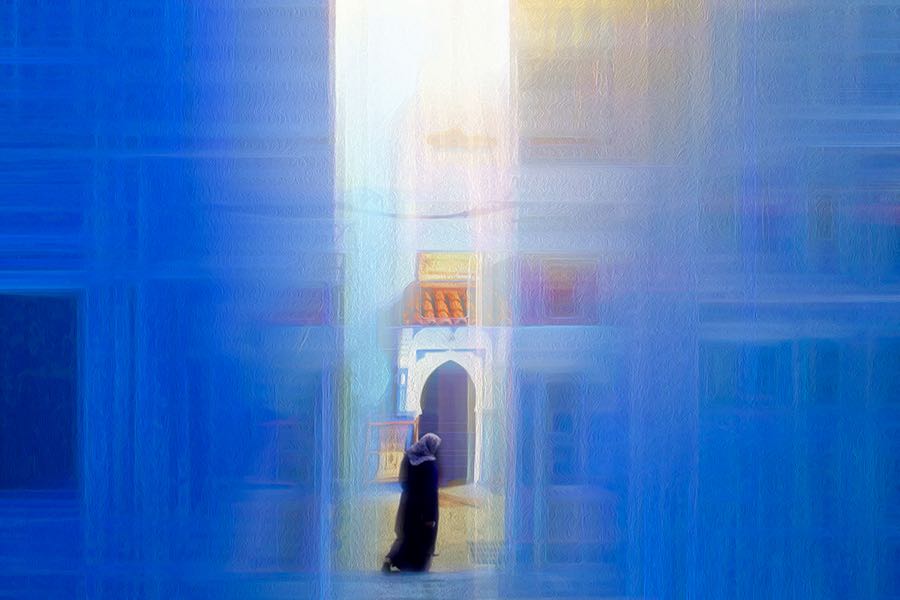
If you close your eyes you can see her, standing, wearing the blue flowery dress, and the tight veil to contain her strong thick long hair, while cooking. You can see her in that kitchen with sky-blue walls, right before night falls, right before darkness envelops all things.
My childhood can be described through those walls; walls so blue to shine by way of the sun, so blue to be dark water by way of the night.
When I speak to someone about my mother for the first time, I usually tell them: “My mom is crazy and deaf.” She is literally crazy and deaf, since childhood, which is what makes her so special, what makes me love her so much. Our love has been and is a tormented love. I have violently hated her and passionately loved her. I’ve avoided her, concealed myself, and then unmasked again. I punished her because she made me in her likeness: crazy enough to play on the gorge’s brink, deaf enough to not hear the reprimands. I punished her because she created me in her womb. When she came back from the Hajj, the most important Muslim pilgrimage, I blessed her with a weightless kiss on her eyes. I forgave her, and perhaps I forgave myself as well.
If my mother wasn’t as bizarre as she is: a bizarre Muslim, a bizarre mother, a bizarre daughter, wife, sister, and a bizarre human being, I couldn’t be as free as I am today.
Her name is Fatna: an old Arabic name that doesn’t suit her, because she is still a little girl, just a suburbia Maghrebi raised with bread and tradition.
I go insane periodically. I swear it’s a thing. It might be due in part to my childhood, in part to this bridge between two realities, two cultures, where there has always been crack, almost like a crevice. Most of the time, it can be described as an open wound, annoyingly bleeding. It can be grasped, every time I need to explain the meaning of an Arab word, and there is no Italian word to match its essence. This crack can also be perceived in your dreams, and in the sound of your thoughts. In what language do you think? In what language do you dream? What conscience is driving you? One more question, the most important of all: in what language you love the soul of others?
Now, close your eyes. Do you want to play a game?
Breathe deeply, and picture to ease down on my parents queen bed. The pillows have flower patterns; there is a dresser and a shabby chic mirror in front of the bed. Qur’an verses are pasted on the wall, and a star has been finger painted with henna. They call it superstition but it’s actually faith, and it is strong. It is so strong that it changes a mother into a daughter, and vice versa. It is so strong that it fuses with love, it creates an entanglement of missteps and hugs, of tears and bonds going beyond everything, even the word of God.
Look around: did you notice how messy this room is? It isn’t my parent’s room anymore. Neither of them have been sleeping in here for a long time. It is my brother’s room now, and it is mine when I visit them. I’ve always been the favorite one, their last hope.
Sometimes, when I am in this house, I can’t sleep for days. It feels like the sheets of this forgotten bed are capturing my soul and body. It feels like being suffocated. An affliction, a truth, or maybe more than one.
Afflictions, just like truths, can be heinous. They can turn into a labyrinth, where we lose ourselves, where there is no shiny thread to guide us through the darkness, especially if that darkness is deep in your eyes.
My insanity is not only cyclical, it looks like a fruit: it ripens with time, with the warm season, and sometimes with the cold season. It increases awareness. Awareness is a gift: a step toward the heaven of my personal ascension, a component for the evolution of my soul, the tree breeding the fruit of principles. One needs to be careful to not get hit by the fallen fruit as it could dismiss one’s mind. I believe that this is the original sin: dismiss ourselves, not to wonder about who we are.
Let’s go back to the initial room.
If you could inhale the room, all in, you would be able to finally breath; alas, you’ll need to be satisfied by the open window, to breath amidst the world.
My mother is breathing with you. She’s sitting on the outskirt of the bed, she’s looking at you, and she’s listening while you are telling her your thoughts. They are, and have always been much clumped thoughts. Do you feel them clench?
Do you know why I do not often wear bracelets or necklaces? To not feel constricted. From the time of this realization, I was able to free myself from restraint.
That day I was telling you about, sitting on the old forgotten bed, was the day I made my mother stronger by breaking her heart. I made her what I wanted her to be: a mother, regardless of insanity. I wanted her to take responsibility for my identity. I looked at her, mad and scared, and told her who I was, take it or leave it. “I don’t need a man to take care of me” were the exact words. “I already have someone, and that someone is a woman”.
I’ll be honest: it was really hard. It was hard to tell for so many reasons. It was really hard because I felt I didn’t have the proper vocabulary for a situation of such importance. I wish I could have opened my heart, told her my problem was never college, work, men, my father, my childhood or the other thousand things she tries to pin it on, and neither was the constant, incomprehensible to her, inner sadness. I wish I could have told her my sadness comes from the full awareness of who I am, from my full will of wanting to know me, and yet from the constant feeling of being irreparably wrong, entrapped, and guilty.
My mother’s reaction, to my few words, was to hobble away, possibly sobbing: she looked so fragile to me. She laid in the living room, and asked me to leave: “I can’t accept it. Not this!” she said with tight lips and lost eyes. To me, my mother always resembled a storm: her face could express so many emotions within a few seconds; it was frightening. The specific veil she used to wears intensified the vortex of the oviform face. However, that day my mother went pale, she didn’t want any expression to have the upper hand. Perhaps, something broke inside her, and she didn’t want to be visible from the outside, or at least not in front of my father. She tried to cast me out, from her house and from her heart, but she didn’t succeeded or simply didn’t really want to.
My sister was very caring that day. At least, as much as a sister can be considering she also assumed the role of mother when I was a child. She was loving, although my revelation caused her -and is causing her- much grievance. It is possible I was overbearing and selfish. I thought about that a lot, in the past few months. I even thought about it while writing this piece, but I concluded that -although indirectly- it was really my sister that suggested it. Perhaps, I have taken the most difficult path, but I am sure the view will be breathtaking.
Sàida
translation by Barbara Burgio
©2017 Il Grande Colibrì
Second Generation Queer: the other accounts:
1. How I’ve Killed My Mother
2. I Am Happy Because I Love Myself