
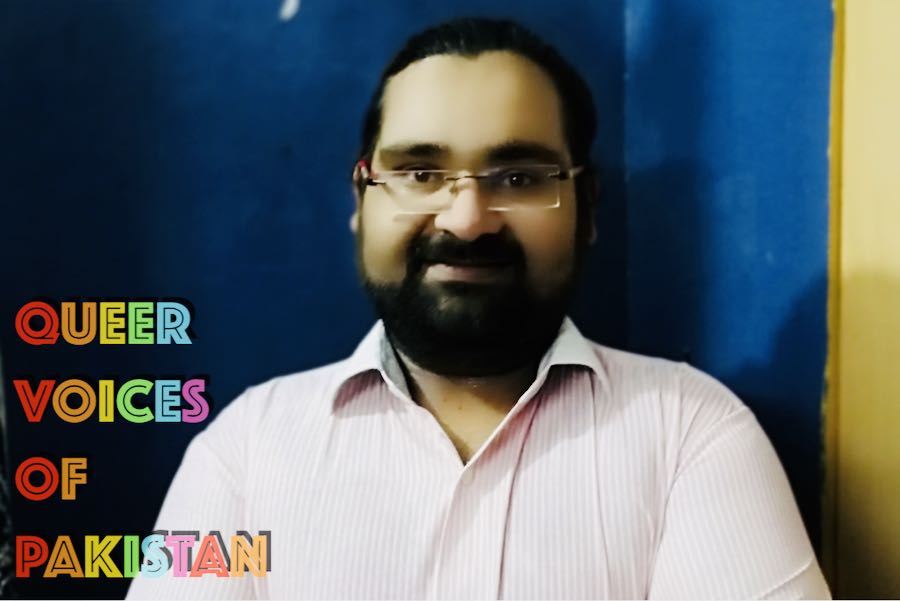
Pakistan is a country where the queer community is discrete and private. Those who are privileged usually keep distance from their own community to avoid any associated stigma. In this suffocating environment, Dr. Usman Hakimuddin is a hope for the queer community of Hyderabad. He dedicated his personal and professional life to the community, which is especially remarkable when you belong to a conservative society.
Dr. Usman Hakimuddin, a graduate from Isra University in Hyderabad, Pakistan has been working for the Pakistan queer community since 2015 with community based organization (CBO) working for the welfare of gender minorities like Naz Male Health Alliance & Humraz Male Health Society. He currently runs a free space for the queer community in Hyderabad, Pakistan which main purpose is to socially support each other and freely discuss issues.
How would you define the current health status of the queer population of Pakistan?
Pakistan has always given the least importance to the health of its population and when it comes to the queer community which has already been neglected by the government, the community is at high risk of STI (sexually transmitted infections) particularly HIV/AIDS. Lack of sex education and safe sex practices has been the reason behind the vast spread of STI among the queer population, and the stigma and discrimination by the health officials keep the queer community from consulting a doctor regarding their sexual health problems thus transmitting the diseases among others
What ratio of transgender and MSM (men to men sex) has resulted in the transmission of STDs in their lifetime?
Data from six CBO’s working on MSM and transgender communities in Pakistan shows that sexually transmitted diseases are at high risk and without proper diagnosis and treatment the numbers will keep increasing. The report shows that from 2012 to 2016 nearly 19.4% of all transgender and 17.8% of MSM who registered with CBO suffered from various type of STDs.
It is an alarming data point considering these numbers are covering only five cities. If the data was encompassing the entire country, the probabilities would be higher.
What is the ratio of the queer community living with HIV and do you consider the ratio alarming?
Pakistan has been classified as a concentrated epidemic country, which means according to WHO/UNAIDS (World Health Organization/United Nations AIDS) that at least 1 person within the at risk groups (as defined by the risk behaviours above) HIV prevalence has exceeded 5%. In Pakistan there are two groups that have reached epidemic proportions: Injecting Drug Users at 37.8% and Hijra Sex Workers at 7.2%.
In current 2017 IBBS, the prevalence of HIV has increased from 3.2% to 5.1% among MSM/MSW while in Hijra/TG TGSW in the past few years has been steady at 7.2%. Although, no segregated data is available to differentiate the prevalence among MSM/MSW TG/TGSW and HIjra.
Are sexually transmitted diseases considered taboo, especially in consideration of queer people?
Sexually transmitted diseases (STDs) are considered as taboo regardless of gender or sexual identity. Doctors are still reluctant to gather patient’s sexual history information, thus treating the patients for the wrong condition. Even the general population is hesitant to give the correct health history to doctors due to the stigma and discrimination surrounding STDs. Doctors are preaching to them about religious obligations and judging their sexual behavior and activities, making the patient reluctant to seek medical attention in future.
The queer population, that is already marginalized and considered as a social taboo, is easily targeted when suffering from any STDs, not just by the general population but also within the community itself.
What is the general perception about sexually transmitted diseases amongst the queer community of Pakistan? Do they take it seriously?
The queer population is still not fully aware of STDs as there is no sex education in Pakistan and even talking about sex is considered taboo. People tend to have knowledge of HIV/AIDS but they lack the information regarding STDs and thus the prevalence of STDs among the queer community is increasing rapidly. The queer community is vulnerable to infections from various types of STDs but related stigma and discrimination makes it tough to get consultations or even information concerning safe sex measures.
Is safe sex becoming a practice amongst the queer community of Pakistan?
The majority of the queer folks are using condoms thanks to awareness campaigns, social media groups, or by visiting various NGOs (non-governmental organizations). These platforms are providing awareness regarding safe sex practices and STD diagnosis and treatment.
What are the biggest hurdles in promoting precautionary measures?
Even condoms are discouraged in Pakistan and a person needs a lot of courage to go to a store and ask for it. This kind of conduct increases the incidence of people having unprotected sex and thus increasing the chance of contracting STDs.Various NGOs are providing free condoms to the community but they also have limited resources.
The government needs to have a safe and free access to condoms initiative, especially for the marginalized and the sex workers. Proper sex education can prevent STDs but citizens are generally unaware of safe sex practices because of the Islamic conservative views in the country.
People have linked the spread of STDs mainly to the queer community. Do you think it is an exaggerated statement?
In regard to Pakistan I can say: “It’s an exaggerated statement.” The queer community lives in constant fear and remains very discrete. Also, the access to female sex workers is comparatively higher than male sex workers.
Medically speaking the symptoms of sexually transmitted infections are vague and difficult to diagnose in both men and women. Thus men who suffer from STDs can be diagnosed and treated at an earlier stage compared to women which remain unaware of having an STD and can spread the infections to others.
What is the status of queer healthcare services provided by public and private sectors?
In 2012 Naz Male Health Alliance started working on the health issues of the queer community by opening CBO’s (community based organizations) in various cities of Pakistan. Their aim was to access the LGBTQIA community: provide them with free HIV testing, counseling, diagnosis, and treatment of various types of STDs.
The government at that time turned a blind eye and completely neglected the queer community even in IBBS reports. At the beginning of January 2018, the NACP (National Aids Control Program) started focusing on the LGBTQIA community and in collaboration with The Global Fund, opened various community locations where people can get free HIV testing and STD related medications.
What is exactly the role of community based organizations (CBOs) -for queer communities- in elevating the health standards?
Since 2012 when several CBOs were opened by Naz Male Health Alliance to promote HIV/AIDS and STD awareness, we have seen an elevated behavioural consciousness: people started using condoms and getting periodic HIV testing.
These centers are run by community members, therefore people are more at ease in talking to them about their health issues. The appointed doctors even have adequate knowledge of gender identity and sexual behavior and so the community was less reluctant to be examined or treated. These CBOs provide free HIV testing, free STD treatment, and along with that provide free condoms and lubricants to the community.
What public or private facilities are available for transgender people who wish to pursue complete transition?
The government has not provided any facility where to get proper hormone therapy or psychological evaluation. I would say that’s an alarming situation because most of the transgender community don’t consult a doctor when it comes to hormone therapy, but rather take whatever medication and amount used by other transgenders which could result in improper dosage and unwanted side effects.
There are a few private medical practitioners who are providing psychological evaluation for the transgender community and they can forward their evaluation to doctors who can prescribe a proper hormone therapy but because they are few in number they cannot cater to the whole transgender community. Sex reassignment surgery is not legalized in Pakistan and thus those who undergo orchiectomy (the removal of testicles), mastectomy (the removal of breast) or breast implants are confined to private practices that do not follow legal procedures.
What is your message to Pakistan Medical and Dental Council (PMDC) regarding the issues within the queer community of Pakistan?
PMDC needs to revise its curriculum: must include topics on sexual orientation and gender identity directed to medical students because right now most of the psychiatrists and psychologists consider being queer a mental disorder. Also, they need to include chapters on sexually transmitted infections (sign, symptoms, diagnosis, and treatment) and must call for mandatory sexual history survey from all patients regardless of gender.
The PMDC and the government should press on the health care providers to be more sensitive about the queer community so to eliminate the stigma and discrimination faced by queers. It is a basic human right for each and every individual to get the best possible health care regardless of gender.
What is your message to International Health Organizations, which are known for establishing health standards?
Pakistan needs health reforms especially for the queer community (currently neglected in the policy making) which are at a higher vulnerable risk of HIV infections and other STDs. International organizations are receiving data regarding the health status of queer communities showing the increase in prevalence of HIV, concentrated in the epidemic phase. The reason behind such increase is the stigma and discrimination related to the queer community, especially by the health care providers.
Faysal Zia (Sunny)
©2018 Il Grande Colibrì
photo: Il Grande Colibrì
Read also:
https://www.ilgrandecolibri.com/queer-voices-pakistan-ascoltare/


Sir iam a transmen.Iam suffering from depression and anxiety because of my gender please help me if you can. I assigned female ay birth but i always feel like a men i love to do male activities i want to change my gender but iam not enough brave to tell my family about this. Please help me.