How often do we talk about sexual diversity as the manifestation of a liberation (or a decadence) linked to contemporaneity? While someone is disoriented and sometimes even annoyed by the spread of new words (pangender, genderbender, genderqueer, agender, crossdresser …) to describe differences, the extraordinary artistic and historical work of Ria Brodell, a non-binary and trans artist from Boston (United States), helps us to remember how in every age and in every culture there were people who did not fit in with the identity canons of their societies.
In the beautiful series “Butch Heroes”, collected in a precious volume released in October by The MIT Press (96 pp., $ 24.95), Brodell proposes portraits of real individuals who lived in different cultures in the last centuries, but who had an element in common: assigned females at birth, these people have lived presenting themselves with appearances and behaviours culturally associated with masculinity. Each painting is accompanied by the often tragic story of the painted subjects and a rich bibliography. Il Grande Colibrì talked with Ria Brodell about their most unique and rare work.
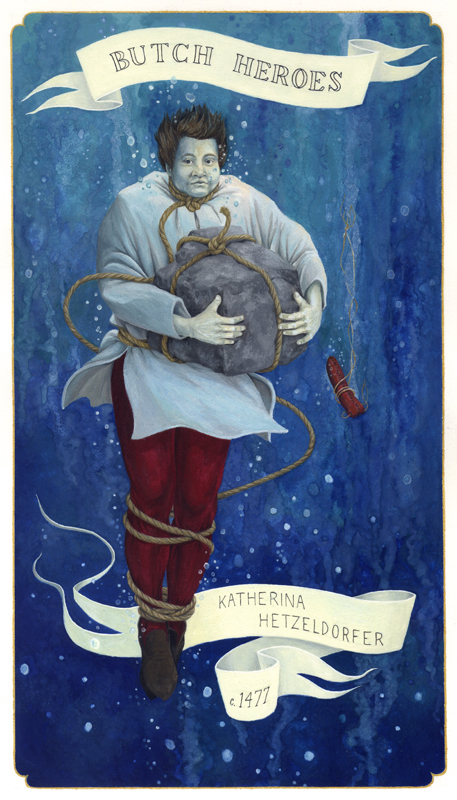
gouache on paper, 11 x 7 inches
2012
In the collection of the Davis Museum at Wellesley College
How do you choose which stories to tell?
I always go back to my initial reason for starting the project– I wanted to know what my life would have been like (as a queer, trans person) had I been born into a different century. The people I choose fit a criteria that relates to me personally- assigned female at birth, presented themselves in a masculine way and had relationships with women. Once I find a person who fits that criteria, then I set about verifying their story.
L’attenzione ai dettagli iconografici e la bibliografia che accompagna ogni immagine dimostrano un importante lavoro storiografico: how do you reconstruct the stories of the people you portray?
I try to find as much information as possible to tell their story in a concise way, and I include my sources so that viewers can do further research if they’d like. When I’m constructing the painting I’m usually choosing to depict a moment in their life that struck me visually, sometimes I depict them at the time of their death, other times they are working, or just living their every day lives- it really depends on the narrative and what I feel works to get the essence of their story across.
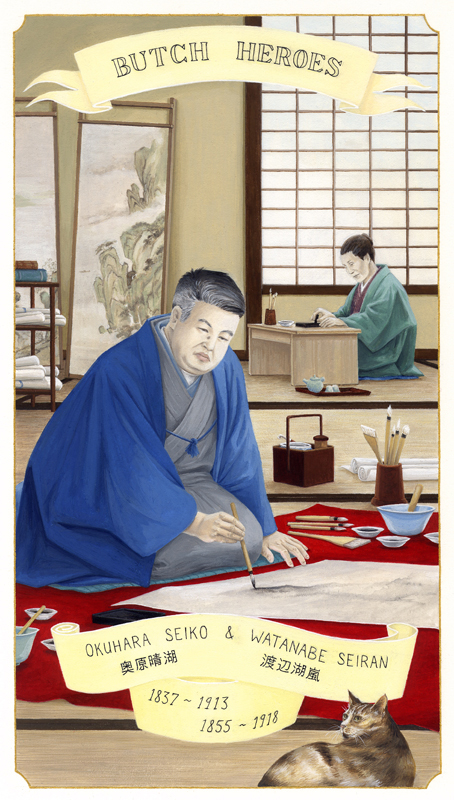
1837-1913 and 1855-1918 Japan
gouache on paper, 11 x 7 inches
2013
In the collection of the Davis Museum at Wellesley College
Once I decide how I want to depict them, then I do research on everything in the composition relating to the scene- clothing, tools, their environment (interiors–furniture, wall hangings, lamps etc., or landscapes–buildings, streets, trees etc.) It takes a lot of research. I want everything to be as accurate as possible.
Why is it so important for you to tell these stories?
I think it’s important to tell their stories to emphasize the fact that gender variance and sexual variance has existed throughout time and all over the world. The LGBTQIA community (to use contemporary terminology) is not included in most history books, our lives are not taught in schools, our stories are often actively ignored. It is extremely important to bring our history to light.
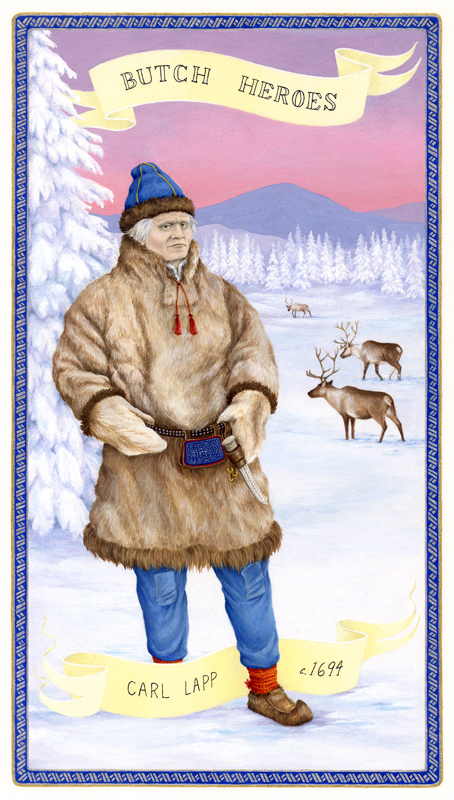
gouache on paper, 11 x 7 inches
2012
Your work is populated by people of different geographical, ethnic, cultural and religious backgrounds. Do you think these diversities within the actual queer community are adequately recognised?
No, I don’t, unfortunately. Especially, when looking at historical research. It’s incredibly difficult to find information about people of color, people from indigenous societies or people from non-western and non-Christian cultures. Often I will find stories, but there will be no name recorded or an inadequate amount of information. It’s as if those recording the information didn’t think they were important. It’s incredibly frustrating.
You define the people in your portraits as “butches”: why did you choose this word?
I have never intentionally defined my subjects as “butches.” In fact outside of the title “Butch Heroes” I never use contemporary terms to define or describe them. I chose the word Butch for my title because it’s a concise term associated with masculinity (in appearance and actions), and bravery. It also has a history within the LGBTQIA community and is familiar to the cisgender, heterosexual community. It’s a word that has become a sort of bridge between generations within the queer community. In my personal history, it has been used as an insult towards me, but also as a congratulatory recognition of strength– I enjoy that dual nature.
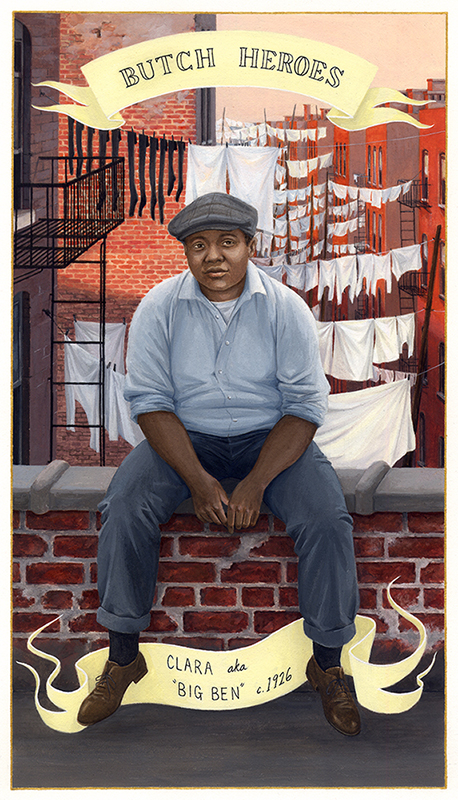
gouache on paper, 11 x 7 inches
2014
In the collection of the Davis Museum at Wellesley College
Today we have a lot of possibilities to define ourselves, our sexual orientation and our gender identity, but most of the people portrayed did not have a precise and non-offensive term to describe themselves…
Exactly. And I have no way of knowing how they would define themselves given our choices, and I don’t want to put them into a “box” in which they may or may not identify: language is incredibly important when it comes to finding community, but it’s such a personal choice. That’s precisely why I don’t use contemporary terms when referring to, or describing my subjects. I try to tell their story and depict them in a way that reflects the way they presented themselves, the way they talked about themselves.

gouache on paper, 11 x 7 inches
2011
In the collection of the Davis Museum at Wellesley College
From an iconographic point of view, your portraits explicitly reproduce the holy cards of the Catholic tradition. The cover of your book is very reminiscent of religious books, Bibles and missals. It’s not just a provocation, is it?
Oh not at all, it’s meant to be a little bit provocative but also homage. I love the iconography of Catholicism, and though I am no longer Catholic, the historical figures of the church, the saints in particular, still hold a special place for me. I felt the holy card format, and the book’s reference to a church missal or bible was the perfect format. First, because it’s part of my personal history, these objects are used as teaching tools and they were used to teach me about the saints and the church. Second, because holy cards are used in reverence and remembrance.
So, what better way to remember and learn about the subjects of “Butch Heroes”? This is where I am intentionally being provocative, because many of the subjects of “Butch Heroes” were often punished by the church, or by their Christian community.
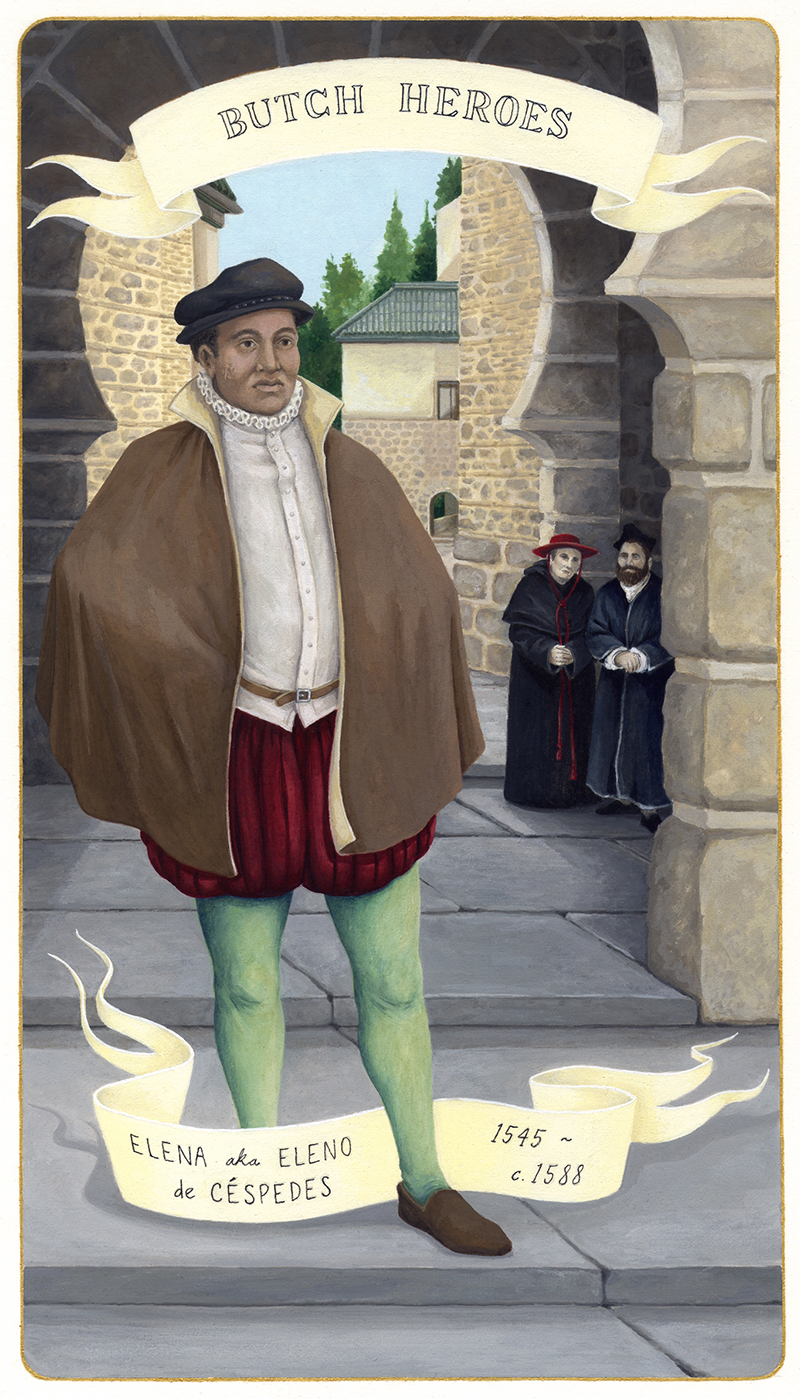
gouache on paper, 11 x 7 inches
2011
In the collection of the Davis Museum at Wellesley College
Pier Cesare Notaro
©2019 Il Grande Colibrì
photo: ©RiaBrodell – Il Grande Colibrì
Read also: