I distinctly remember walking along Habib Bourguiba Avenue, the main road of Tunis, with Badr Baabou. He is a friend, and one of the most prominent figures in the queer and human rights movements in Tunisia (he received an award from Front Line Defenders in 2019). On that day, he told me of the projects he was carrying out with the Damj organisation (meaning “inclusion”) and other civil society groups working for the Tunisian LGBTQIA community (lesbians, gays, bisexuals, trans, queer, intersex, and asexuals), for women, for sexworkers. On that road, a symbol of the revolution, he could finally talk to me in person (after keeping in touch through the internet since 2011) about the ongoing struggle for freedom and democracy, with all its hopes and anxieties. And its dangers.
There, between Habib Bourguiba Avenue and the pedestrian zone around Rue de Marseille, four people assaulted Badr last Wednesday, a few feet away from a group of police officers who did not as much as lift a finger. That was to be expected: a few days before, the police themselves contacted the activist’s landlord, to pressure him into breaking the tenancy contract, to avoid trouble. The assault was the final step of a years-long continued and increasingly heavy harassment strategy. In 2018, someone broke into his home in order to steal documents regarding him and Damj. Uncountable times, he received insults, pressure, death threats.
Increasing violence
The whole Damj organisation and the queer movement, not only Badr Baabou, are also targeted by this persecution, especially now that LGBTQIA people are strongly aligned with the social justice movement grown in working-class neighbourhoods. Violence, arrests, and intimidation are more and more common, as sociologist Abir Krefa denounced in an article written for Il Grande Colibrì, which has now become a statement signed by dozens of other organisations. Recently, Damj activist Rania Amdouni was sentenced to six months imprisonment for acts against public morality and contempt of police, for her resistance against policemen harassing her.
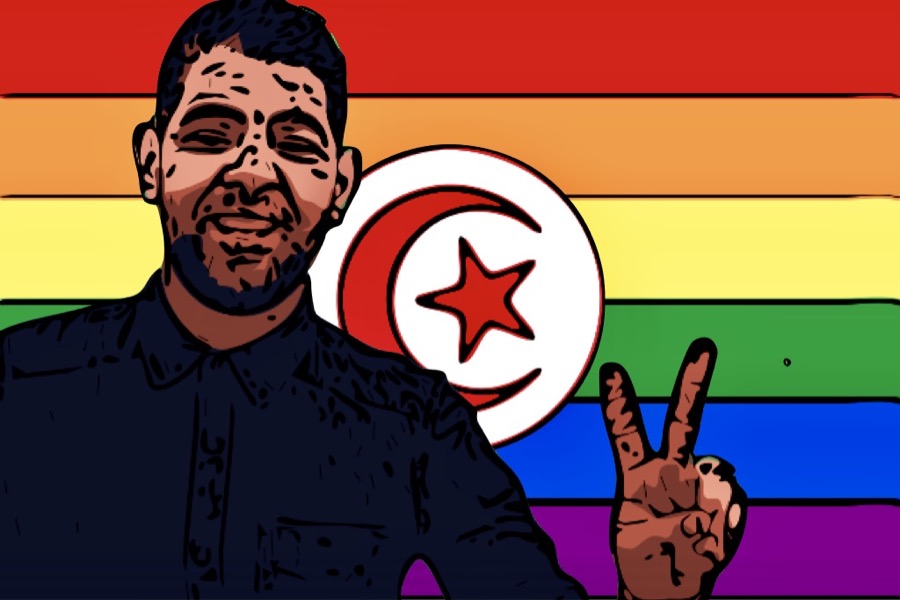
“I will never be afraid of them and they will never manage to silence me — Badr tells Il Grande Colibrì — some people paid with their lives, and I am no better than them.” Damj will also not give up: “We are fully aware of the consequences that result from our choices in defending the most vulnerable groups and the least permeable to rights and freedoms, and we adhere to our intersectional approach against all forms of oppression, stigmatization, discrimination, violence, negative stereotyping, hatred and confronting all forms of human rights violations, on top of which are institutional violence and police oppression.” The organisation raises its stakes, asking for dignity and social justice for everybody in Tunisia, in order to stay on the same path marked by the results achieved during the revolutionary process.
More revolution
The escalation of threats and violence clearly shows how the police and the ruling élite are increasingly afraid of protests that merge together the democratic demands of more and more groups (including sexual minorities), and are afraid the lock holding down rights and liberties in the country may be broken, wiping out the privileges of the oppressors. These are very dark days. But talking about the end of the revolution is not only wrong: it has the only effect of strengthening those who do not want change; those who, as Badr says, “want to build their own privileges upon our shoulders”.
“We are victims of unprecedented violence, perhaps worse than under the dictatorship of Zine El-Abidine Ben Ali, whom we have thrown out — Badr Baabou again tells us — but we work on the ground, with citizens, we are here, and they won’t be able to send us away, despite the repression. We are well aware that, when defending marginalised and vulnerable people, we will be directly targeted by the police and by bigots, but we’re here to stay, proudly, our heads held high, taking responsibility for our choices.”
Pier Cesare Notaro
translation by Martino Sorbaro
©2021 Il Grande Colibrì
images: elaborations from Damj / from ouss94 (CC0)