During the past years LGBTQIA issues (lesbian, gay, transgender, queer, intersex, asexual) have been more present in the journalistic debate in Iraq. An investigation carried out by IraQueer – the country’s first rainbow association founded in 2015 to inform, defend, and assist the sexual minorities in Iraq – covered local media between 2012 and May 2020 about the way the Iraqi media deal with these topics. It revealed that these issues have always been addressed in a discriminatory way and are considered extraneous to Iraqi society.
Read also: A Giant Online Outing Campaign is Underway in Morocco
Offensive words
Sexual diversities are not only portrayed as “disorders that need to be cured and eradicated” but there also have been cases in which the media pushed as far as to promote “the elimination of LGBT people from society” aiming to “defend the younger ones” whom could be “easily influenced”.
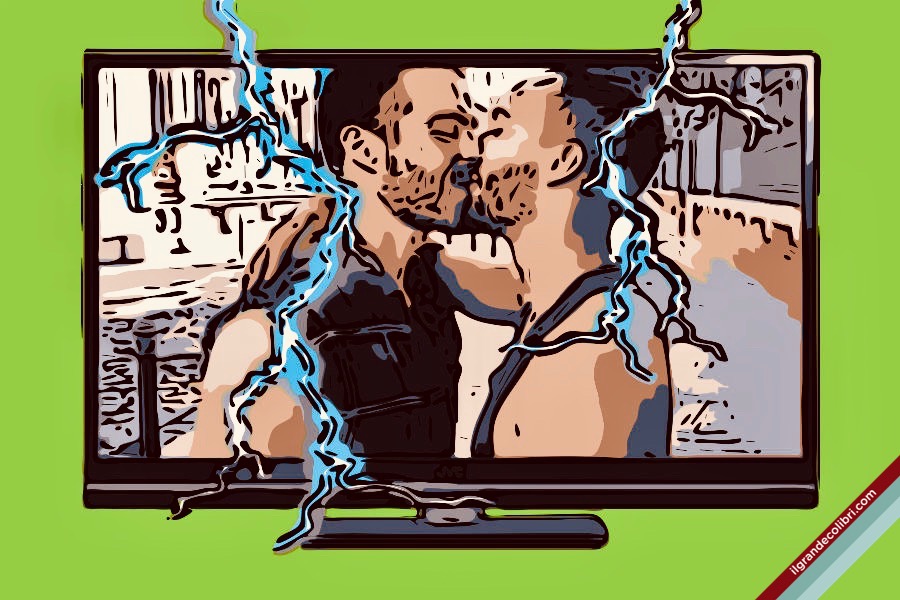
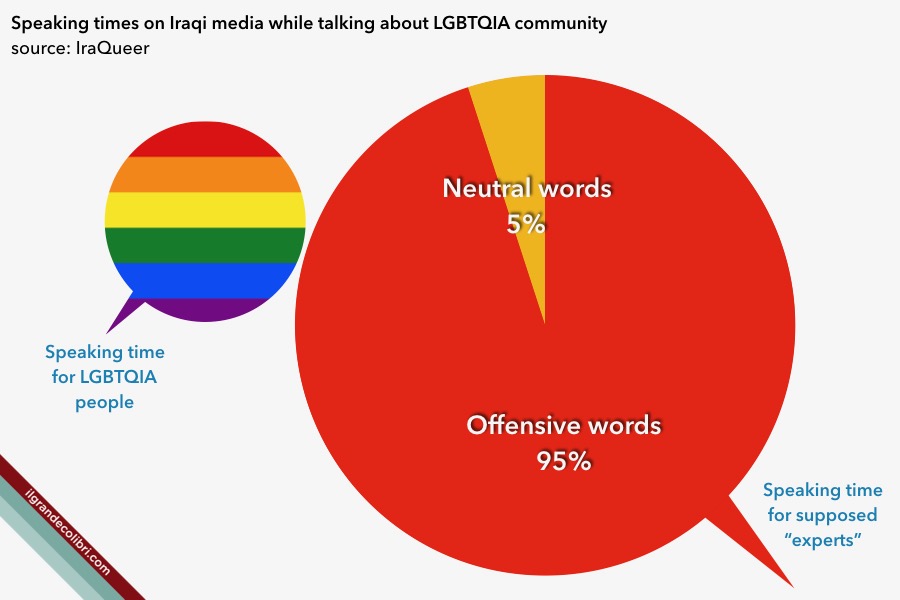
Prejudice and discrimination are mostly enhanced by TV shows- which are the source of information for 92% of the people in Iraq. In the television programs examined by IraQueer, LGBTQIA people had the floor for an average time of 5 minutes, while those who criminalized them spoke on average for 31 minutes. When the topic was addressed, offensive (even crude) words were used once every 30 seconds against LGBTQIA people for a total of 1,574 times. Even the structure of the programs is discriminatory: the topic is introduced as “controversial”, the interviews are filmed in abandoned or dark places and they often use dramatic music.
 Hate ‘experts’
In the construction of homophobic narrative, an important role is played by the “experts” called on the show. They often list a series of reasons why a person could “become LGBT“: birth problems, hormonal problems, mental illnesses, sexual abuses, lack of a family guide or moving away from religion… The idea that being non-cisgender and heterosexual is something natural has never been considered.
The “experts” use words like “sin“, “cure“, and “prevention” but also “punishment” and “crime” while they propose “solutions” ranging from the request for greater control by the families to the development of policies that can “reintegrate” these young people into society after having “treated” them. The “experts” base their claims on vague sources (“recent international studies say that…“, without mentioning which studies are being considered) or completly false ones (for example in 2018 it was said the World Health Organization regards homosexuality as a mental disorder while it was eliminated from the list of these disorders in 1992).
In most cases in these TV shows there is a lack of guests who have other views. When LGBTIA people are hosted they start from a clear disadvantage: they cannot boast specific studies on the subject, they do not have economic stability and they do not have the political, religious, and social protections that the “experts” have.
Read also: Iraq was already Hell for gays, now it’s even worse
Negative influences
However, the LGBTQIA community’s existence in Iraq is made almost impossible not only by the media but also by the school system, the political and social instability in the country, and the pressure perpetuated by the religious and tribal groups.
The media behaviour definitely doesn’t help: a study conducted by IraQueer in 2018 shows that 89% of LGBTQIA people agree the media have a negative impact on how they perceive their identity.
As a matter of fact, the Iraqi TV had systematically promoted hate speech and violence against sexual minorities with broadcasts that have even labelled the LGBTQIA rights groups as “worst than terrorists”. This has also alienated those who could be close to the needs of the community that eventually didn’t participate in civil rights groups because of fear.
Alessandro Garzi
translation by Tiznik
©2020 Il Grande Colibrì
image: Il Grande Colibrì