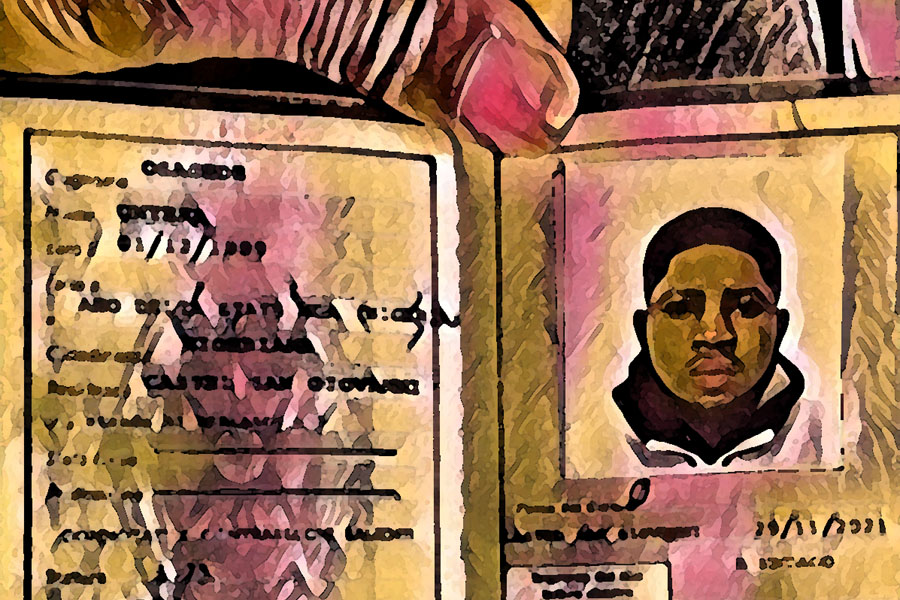
Osake can now celebrate his first Italian ID card. His story sounds pretty incredible, yet we were given proof, thus it definitely is the truth. After fleeing Nigeria, where he risked being killed and incarcerated for being homosexual, and after being stranded in Libya for more than a year, he finally arrived in Italy.
He was still a minor, but for some reason he was given no chance to apply for asylum or to be accepted as unaccompanied minor and deported to Nigeria. Staying there was not an option, so he made the whole journey a second time and once in Italy he was denied for a second time the chance to apply for asylum because he had already been repatriated. Therefore, he went to Switzerland and then Germany, but after a year he was told that – since he had arrived in Italy first – he could only apply for asylum there.
Hopeless, he came back and sought help from his friend Evon, who lived in Italy and whom we were already assisting. Evon, who is now a refugee, got us in touch with him and, with the help of the UNHCR, we finally managed to get his asylum application started. Sadly, Osake had been placed in a reception centre that was not doing its job, and did not issue residency papers. We shook heaven and earth and finally Osake was moved to a reception centre we work with, that granted him a residency. And now he finally holds his first Italian card in hand. That’s a huge accomplishment for him.
Did you know that obtaining residency is by no means a given?
An identity card in Italy is essential to activate the SPID [a digital recognition system to access public services, ed.], open a bank account, sign a work or lease contract. But to hold an ID card is needed to have residency, and in the case of asylum seekers – who have never had residency in Italy – only reception centres can apply for it.
Actually, the Constitutional Court’s sentence 186/2020 establishes that, for asylum seekers, residency in Italy is a right but, unfortunately, many facilities keep denying it, profiting from the fact that asylum seekers do not have the means to claim that. Therefore, it may happen that an asylum seeker is left without ID for years, plunging them into a vicious circle that could jeopardise their entire integration process in the country. Even if they are then granted some form of international protection.
If you have any question, you can write an email to piacenza@ilgrandecolibri.com
The answers will be published on the Nido del Colibrì page!
translation by Antonio Pauletta
©2022 Il Grande Colibrì